需要了解:onehot独热编码
概述
Fashion MNIST的分类是0-9之间的数字,本文对 类别 进行 onehot独热编码,然后实现
关键代码
keras的独热编码api
train_label_onehot=tf.keras.utils.to_categorical(train_label)

print(train_label[0])
print(train_label_onehot[0])
执行结果如下:
9
[0. 0. 0. 0. 0. 0. 0. 0. 0. 1.]
配置训练模型 指定损失函数
model.compile(optimizer='adam',loss='categorical_crossentropy',metrics=['acc'])
代码
加载数据
import tensorflow as tf

(train_image,train_label),(test_image,test_label)=tf.keras.datasets.fashion_mnist.load_data()
其中 训练 数据有 60000 张图像,测试 数据有 10000 张图像
查看图像数据形状
# 查看形状
print(train_image.shape)

print(test_image.shape)
结果:
(60000, 28, 28)
(10000, 28, 28)
训练数据 有60000个,图像是 28宽 28高,也就是说每个图像有28*28=784个特征
也就是说,在神经网络模型中,输入值 共有 784 个
测试数据 有10000个,图像是 28宽 28高
显示图像
通过matplotlib显示图像
# 显示第一张图像

plt.imshow(train_image[0])
分析图像数据
print(train_image[0].shape)
# 查看最大值
np.max(train_image[0])
图像数据,是0-255之间的RGB值
查看类别数据形状
print(train_label.shape)

print(test_label.shape)
执行结果:
(60000,)
(10000,)
分析类别数据
train_label
类别是数字,每个数字对应一个类别,上面有对应表格,共有10个类别
也就是说,在神经网络模型中,输出层 有 10个 感知机(神经元)
对类别进行独热编码
train_label_onehot=tf.keras.utils.to_categorical(train_label)
print(train_label[0])
print(train_label_onehot[0])

test_label_onehot=tf.keras.utils.to_categorical(test_label)
print(test_label[0])
print(test_label_onehot[0])
图像数据 归一化
将图像0-255的RGB转换成0-1的数据
train_image=train_image/255
test_image=test_image/255

train_image[0]
建立模型
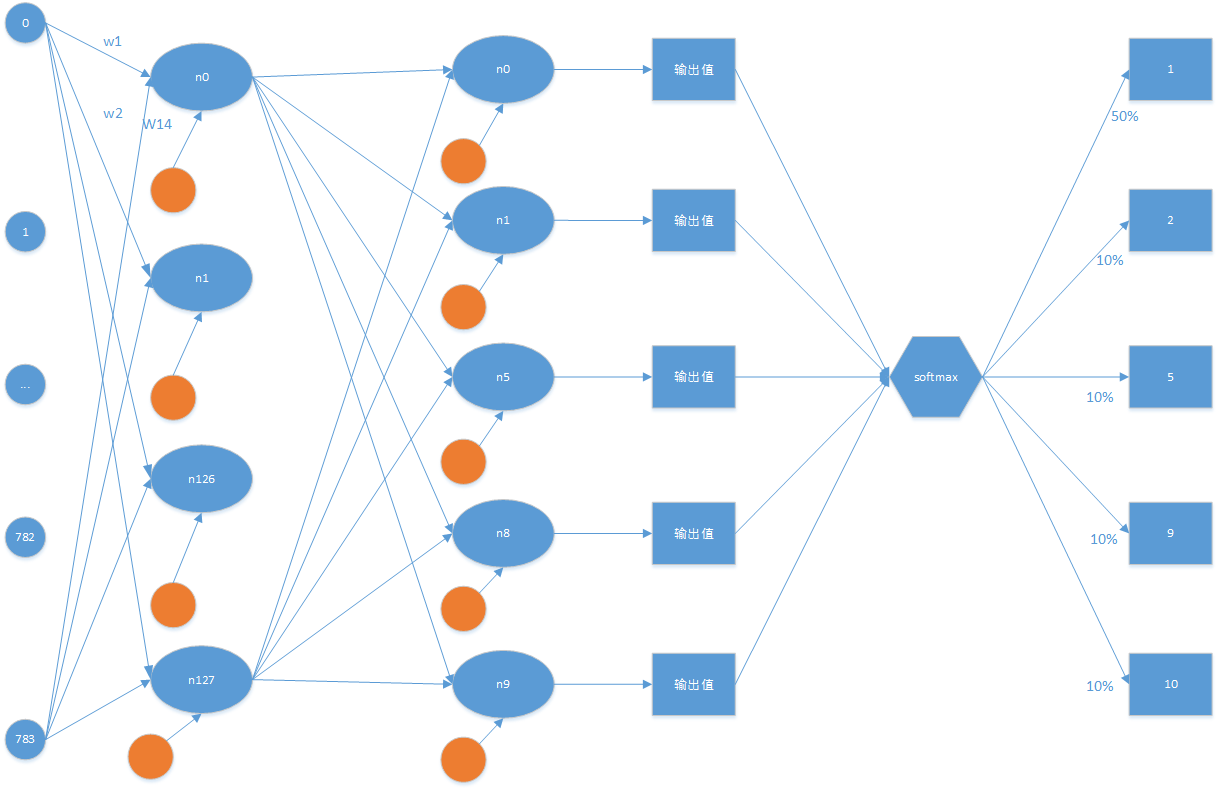
model=tf.keras.Sequential()

# 线性回归中是一维数据,而图像数据是二维数据,需要将二维数据转换成一维数据
model.add(tf.keras.layers.Flatten(input_shape=(28,28)))
# 数量不能太少,会欠拟合,也不能太多,会过拟合
model.add(tf.keras.layers.Dense(128,activation='relu'))
# 10个分类,softmax的作用就是将10个输出值变成概率值,这些概率值之和为1
model.add(tf.keras.layers.Dense(10,activation='softmax'))

model.summary()
配置训练模型
由于目标值 分类 是 one-hot 独热编码 ,所以使用 categorical_crossentropy 损失函数
model.compile(optimizer='adam',loss='categorical_crossentropy',metrics=['acc'])
开始训练
model.fit(train_image,train_label_onehot,epochs=5)
评估模型
评估模型,就是预测训练数据,将预测结果与真实结果做比对,并计算出正确率
model.evaluate(test_image,test_label_onehot)
进行预测
通过模型预测训练数据
prd_label=model.predict(test_image)
查看预测结果
# 预测结果是长度为10的数组,分别表示各个类别的概率,其和是1
print(prd_label[0])
# 获取最大概率的索引
label_num=tf.argmax(prd_label[0])
print(type(label_num))
label_num=int(label_num)
print(type(label_num))
print(label_num,test_label[0])
显示预测结果,并计算预测准确率,看与评估结果是否一致
# 显示预测结果,并计算预测准确率,看与评估结果是否一致
error_num=0
for item in range(10000):
    label_num=tf.argmax(prd_label[item])
    label_num=int(label_num)
#     print(label_num,test_label[item])
    if label_num!=test_label[item]:
        error_num+=1

print('错误总数:',error_num)
print('正确率:',1-error_num/10000)